Dry February Soils: A Reason to Rethink Spring Management?
By: Mike Toohill, AgVenture WSC
Should you be considering spring management changes (planting more defensive hybrids, lowering corn populations and/or cutting preplant nitrogen rates for example) based on February drought conditions? The very dry soils in much of Illinois has been a topic of conversation at winter meetings and I wanted to add my “two cents” to the discussion.
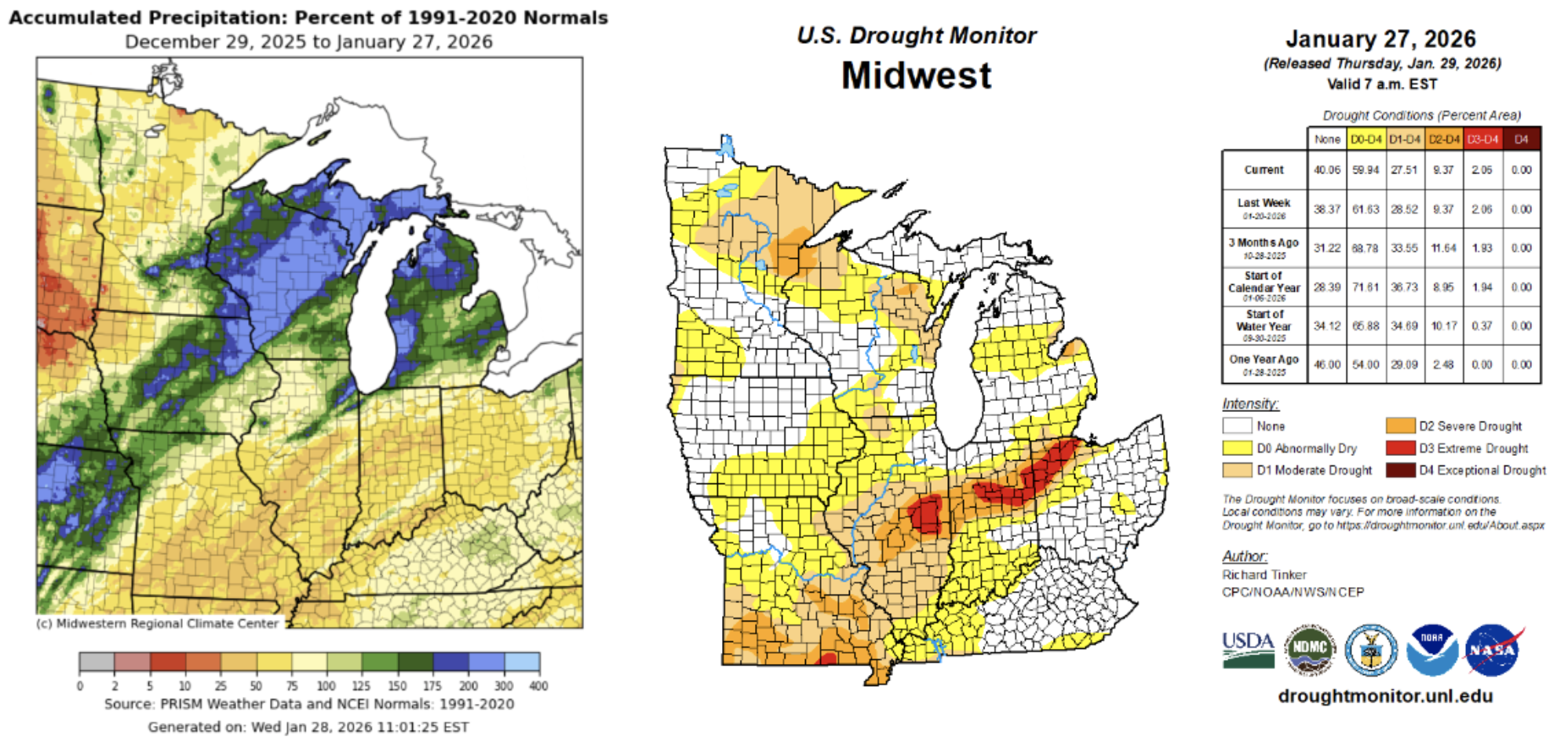
So how dry is it in the Midwest? Let’s start with the 30-day moisture compared to normal map. Over the last month, soil moisture has improved in much of Kansas, Iowa, Wisconsin, northeast Illinois and Michigan. Despite recent snows, Missouri, the southern half of Illinois and almost all of Indiana and Ohio got drier in January. In looking at longer term drought, the most intense drought conditions (RED on the map) are in eastern Illinois, north central into northern Indiana and extreme northwest Ohio.
Back to my question, should you be considering spring management changes based on February drought conditions? In my experiences, NO. Why? Here are my main reasons to stay with the original agronomic plan despite dry winter soils:
It would like punting on first down to me. You never want to limit top-end potential this early in the game.
Drought takes weeks to months to build on medium to heavy soils in the Midwest but a slow 1-day soaker with thawed soils will quickly ease drought conditions. A week of wet weather can reduce drought conditions by up to 2 classifications in late winter and spring in non-frozen soils.
As long as corn and soybeans get enough water for germination and for residual herbicide activation, a dry April and May has little impact on corn and soybean yields based on low early season moisture requirements for the small crops.
When does the lack of soil moisture impact corn yields? Based on the very dry June’s in my central Illinois “backyard” in 2022, 2023, 2024 and parts of eastern Illinois in 2025, record to near record corn yields were still achieved with just in time late June and early July rains. Corn was much more resilient in those situations than most agronomists (including me) expected.
When does the lack of soil moisture impact soybean yields? With mid-April planted early to mid-maturity soybeans, as long as we get good soil moisture by July 10 th or so, high yield should still be on the table. May planted mid to late maturities probably need to start receiving significant rains by August 1 st or so.
Based on what we have learned over the last 4 years, I wouldn’t consider changing management plans due to drought until at least early July.
Related Articles