Late April Heavy Rain Impact
By: Mike Toohill, AgVenture WSC
We had 2.20 end up in the gauge on April 27 here at Bloomington, Illinois (1” in 15 minutes and another ½” in 10 minutes) and it created plenty of problems locally. Corn Belt issues will be widespread in heavy rain areas since quite a bit of corn and soybeans were planted within 2 days of the downpours.
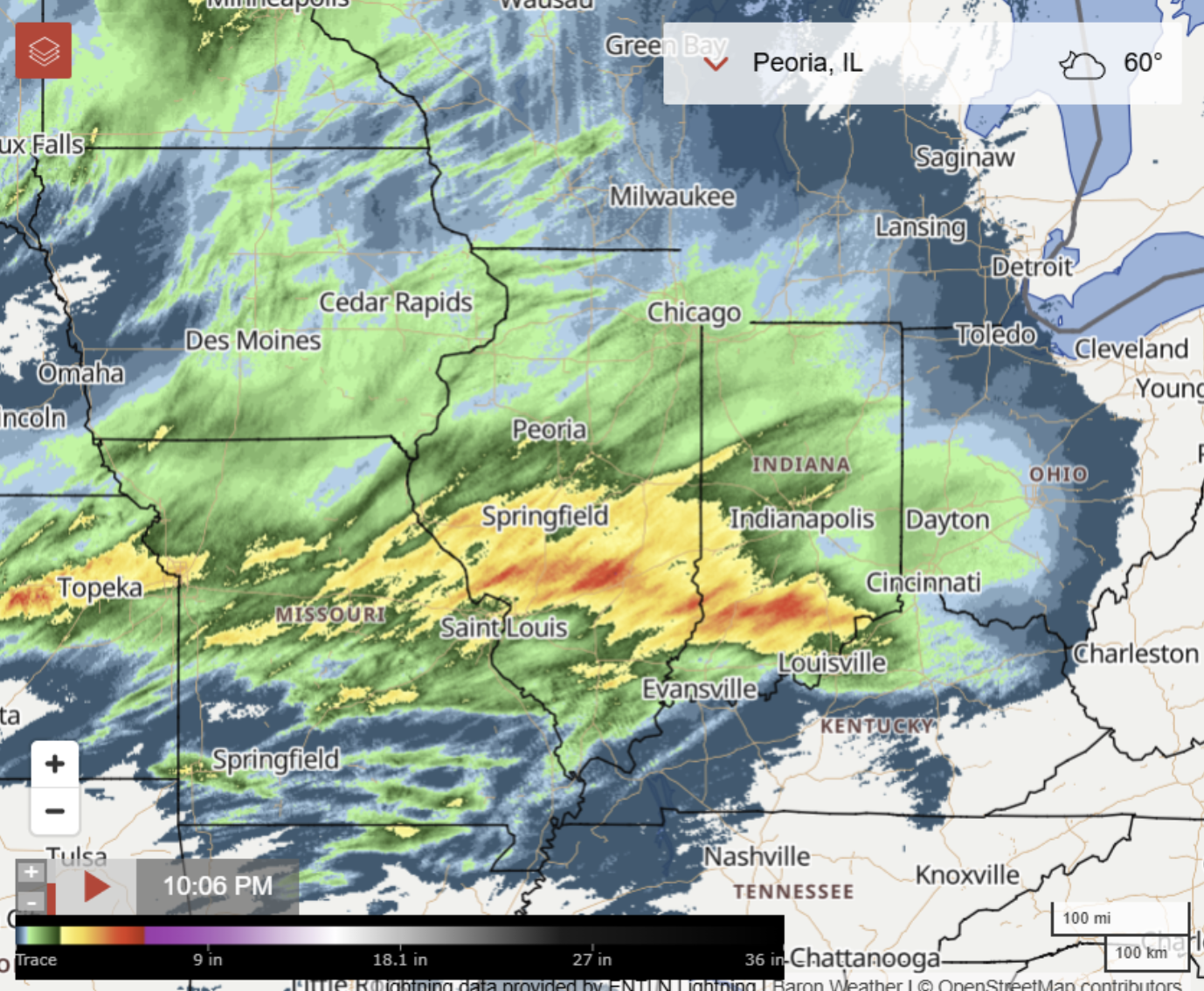
Below I have the 24-hour radar estimates as of bed time on April 27 centered on Peoria, Illinois. With the high rain intensity rates associated with this event, the radar seemed under estimate amounts compared to most farmer’s gauges. The areas I am most concerned about are YELLOW (2” plus) to the RED plus colors (5” plus) on the map although the darker GREEN (1 ½” plus) is also problematic.
Soil crusting for recently planted crops is problem #1: Over my decades walking fields, soil crusting is almost always associated with:
A heavy rain within 48 hours of planting.
Soil crusting is almost always a function of tillage. The closer the planter to the tillage implement, and the closer the planter to the heavy rain, the thicker the crust.
You all know the soil types on your farms that are most prone to getting very hard.
Stand issues from crusting is always worst when it gets hot and windy when the seedlings are close to the soil surface (the plants are growing fast, become more “brittle”, and “break” easier when it gets hot and the crust gets the hardest in these conditions).
How do you know that soil crusting is likely to be bad in a field? When I get out of the truck and finding rows is difficult, the seeds are in trouble…
The “best” ways to mechanically break up the crust?
What about a rotary hoe? Every farmer has their own opinion on the effectiveness (or non-effectiveness) of this tool, but I have had the best luck freeing seedling up when growers hoe while the ground is still DAMP (the hoe can penetrate better) and while the seedlings are well below the ground (limits mechanical damage and also provides a quicker “shot” of oxygen to the seedlings).
Other growers tell me that they like to run the planter LIGHTLY back over the row in hard soil situations. Make sure that the top of the seedling are well below where the planter penetrates though.
The “best” way for Mother Nature to break up a crust:
A well-timed soil softening rain to free the seeds up is always best but rarely occurs over a wide enough area to solve major crusting issues.
For corn and soybeans planted in Illinois on April 25 and/or the 26, that rain would be best around May 7 or so (yep, I expect recently planted corn and soybeans to take a long time to emerge with the expected cool late April and early May temperatures).
How long can seed, seedlings and young plants survive under water? With the cool weather post front (cold water “holds” more oxygen), I would think that as long as the water is/was gone in 3 or 4 little stand loss would be expected.
Washouts, water running down the rows and channeling in bottoms… Will be not easy to “fix” situations.
Related Articles